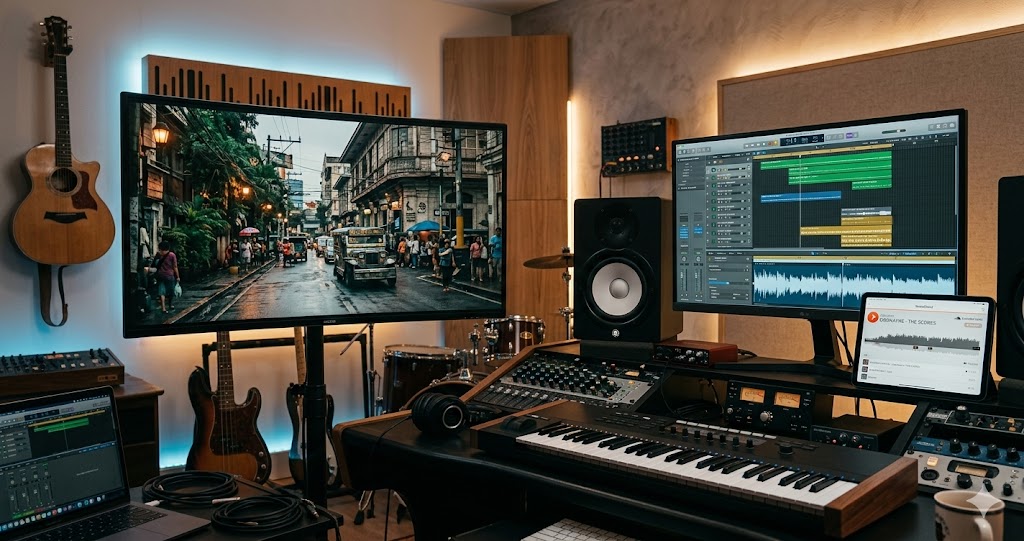
In the rapidly evolving landscape of Southeast Asian cinema, the “sound of stories” has never been more vital. Whether you are an indie filmmaker prepping for a festival run or a game developer building an immersive world, the music is the heartbeat of your narrative. Finding a film composer in the Philippines who understands both the cultural nuances and global technical standards is the key to a memorable production.
In this post, we explore the impact of custom scoring and why local talent like Godwayne is redefining the sonic identity of Filipino media.
1. The Power of Original Scoring vs. Stock Music
Many creators start with stock music libraries to save time. However, a professional film composer does more than just provide background noise; they create a bespoke emotional roadmap.
Narrative Synchronization: A custom score reacts to a character’s subtle breath or a sudden plot twist.
Unique Brand Identity: For commercial ads, a unique “audio logo” makes your product instantly recognizable.
Emotional Precision: From the tension of a Manila-set thriller to the nostalgia of a rural drama, original music captures the soul of the setting.
2. Spotlight: Godwayne Cinematic Portfolio
When searching for a music producer for indie artists or a soundtrack composer for games, versatility is non-negotiable. Godwayne’s background as a graduate of Music Production from De La Salle-College of Saint Benilde provides him with a rigorous technical foundation.
As a multi-instrumentalist proficient in guitar, bass, piano, and even the harmonica, his scores blend organic performance with cutting-edge digital sound design.
Listen to the Sound of Stories
3. Scoring for Different Mediums: Film, Games, and Ads
The requirements for a film composer in the Philippines vary wildly depending on the platform:
Medium
Key Requirements
Godwayne’s Approach
Indie Films
Narrative tension & character themes
Thematic motifs that evolve with the story.
Video Games
Adaptive, non-linear compositions
Music that triggers and shifts based on player action.
Commercials
High-impact, 30-second memorability
Precision engineering to drive audience action.
4. Why Work with a Local Filipino Composer?
Collaboration is easier when your composer understands the local industry’s pace and the “Filipino sensibility” in storytelling. By working with a local professional, you gain:
Seamless Communication: No time-zone hurdles for feedback sessions.
Cultural Resonance: Utilizing instruments or scales that feel authentically “home.”
Support for Local Talent: Strengthening the Philippine creative economy.
Ready to Score Your Next Masterpiece?
The right music doesn’t just fill the silence—it tells the story that the visuals cannot. If you are looking for a film composer in the Philippines who brings technical mastery and emotional depth to the table, look no further than Godwayne.
How Much Does a Film Score Composer Cost in the Philippines? (Rates + What You Get)
Hiring a film score composer in the Philippines can feel confusing at first—especially for indie filmmakers. Some composers quote a flat fee, others quote per minute of music, and sometimes the “cheap” quote ends up costing more after revisions, missing deliverables, or licensing confusion.
This guide breaks down film scoring rates in the Philippines, what really affects cost, and—most important—what you should ask for so you get music that fits the story, edits smoothly, and sounds cinematic even on an indie budget.
Quick answer: What do film composers charge in the Philippines?
There’s no single fixed rate, but most pricing falls into a few common models:
1) Per finished minute of music (common for film scoring)
This is the most transparent model because it scales with the amount of score your film needs.
Typical range (PH market, indie to semi-pro):
Entry / student projects: lower range per minute
Indie films / short films with polish: mid range per minute
Festival-ready / higher expectations: higher range per minute
Full orchestral / live musicians: premium
(Exact numbers vary widely depending on the project, timeline, and deliverables—see “pricing factors” below.)
2) Flat project rate (common for short films)
A composer may quote a flat fee for:
short films (5–20 minutes)
a short documentary segment
a teaser/trailer package
This is convenient, but make sure it clearly states how many minutes of music are included and how revisions work.
3) Package pricing for branded content / ads
Commercial jobs often price based on:
usage (where it will be played)
timeline
number of cut-downs (15s / 30s / 60s)
exclusivity requirements
If your project is both film + marketing (like teasers + social ads), packages can be efficient.
What affects film scoring cost in the Philippines?
If you want to estimate the cost of a film score composer in the Philippines, these are the real factors:
1) How many minutes of music you actually need
A 15-minute short film doesn’t always need 15 minutes of score. Some scenes need silence. Some scenes need minimal texture.
Most short films end up with:
a main theme
a few scene cues
one emotional peak cue
an ending cue
2) Complexity of the sound (solo piano vs cinematic hybrid vs orchestral)
How to brief a film score composer in the Philippines (simple checklist)
When you contact a composer, send this info:
Film duration (and how many minutes you want scored)
Genre + emotional tone
Deadline + festival dates
References (2–3 tracks)
Deliverables you need (WAV, stems, cut-downs)
Where it will be used (festival, YouTube, streaming, theatrical)
Your revision expectations (1–2 rounds is standard for indie)
This makes you look professional—and saves time and money.
FAQ: Film scoring in the Philippines
How long does it take to score a short film?
For indie short films, a realistic timeline often includes:
1–3 days: spotting + theme direction
3–10 days: writing cues (depends on minutes and complexity)
1–5 days: revisions + final export + stems
If your film is near a deadline, start early—music is usually the last piece and the most rushed.
Do I need stems?
If you want a smooth edit and flexibility, yes. Stems help editors:
lower music under dialogue
remove drums for calmer moments
extend endings
rebalance scenes without calling the composer again
Is it okay if a composer uses my film score in their portfolio?
Usually yes, as long as it doesn’t release spoilers and your premiere plans are respected. Set an agreement: “Portfolio use after release date.”
Looking for a film score composer in the Philippines?
If you’re searching for a film score composer in the Philippines who can deliver cinematic music for films, short films, documentaries, and trailers—Godwayne is available for collaboration.
How to Hire a Film Score Composer in the Philippines (Director’s Checklist)
Hiring a film score composer in the Philippines can level up your film instantly—when it’s done right. The right score can strengthen emotion, improve pacing, and make your scenes feel “bigger” even if you’re working with an indie budget.
The problem is: many filmmakers only think about music at the end, when deadlines are close and the picture is still changing. That’s when budgets stretch, revisions multiply, and the score becomes stressful instead of exciting.
This guide is a step-by-step checklist you can follow to confidently hire a film composer in the Philippines, communicate your vision clearly, and get professional deliverables (mixes, stems, and versions) that make your edit easier.
Step 1: Decide what you actually need (before you message anyone)
A lot of productions say “We need a score,” when they really need one of these:
A) Full narrative score (most common for shorts)
main theme + 3–10 cues
emotional peak cue
ending cue
B) Minimal underscore (documentary / drama)
textures and tension beds
subtle themes
transitions
C) Trailer / teaser package (often forgotten)
15s / 30s / 60s cuts
stingers and hits
social edits
If you define the scope first, you’ll get accurate quotes and fewer surprises later.
Step 2: Prepare a proper “composer brief” (copy/paste checklist)
When hiring a film score composer in the Philippines, send this in your first message:
Film length (runtime)
Music minutes estimate (ex: “6–10 minutes of score”)
Genre + tone (ex: coming-of-age drama, hopeful but restrained)
Deadline (festival date / picture lock date)
Reference tracks (2–3 links)
Scenes needing music (timestamps if possible)
Deliverables needed
WAV mix
stems
cut-downs
alt versions
Where it will be used (festival / YouTube / streaming / ads)
Revision rounds expected (1–2 is normal)
The more specific you are, the more cinematic the result will be—and the cheaper the process becomes.
Step 3: Listen for “story thinking,” not just nice music
When you review a composer’s portfolio, ask yourself:
Do the tracks build naturally?
Are transitions clean?
Does the music feel like it supports character and pacing, not just “cool sound”?
A good film composer thinks like an editor and storyteller.
Listen to one of my composition.
Step 4: Ask these 10 questions before hiring
Use this as your director’s checklist:
How do you prefer to do spotting (call/video notes/timestamp list)?
Can you deliver WAV + stems?
How many revision rounds are included?
What happens if picture changes after scoring begins?
Can you provide alt versions (no drums, lighter, short ending)?
What’s your typical timeline per minute of music?
Do you handle final mix/master, or do you deliver to a mixer?
What is your policy on credits and portfolio use?
Are you able to match reference style without copying?
What’s the best way to give feedback so you can move fast?
A professional composer will answer confidently and clearly.
Step 5: Understand pricing models (so you don’t get stuck)
Most film composers quote one of these:
Per finished minute (most transparent)
Flat project fee (works for shorts, but define scope)
Package rates (best for trailers and ads)
Always confirm:
number of minutes included
deliverables included
revision limits
payment schedule
Step 6: The deliverables you should request (minimum)
If you want your post-production to go smoothly, request:
✅ Final Mix WAV (48kHz/24-bit if possible) ✅ Stems (4–8 stems: strings, perc, synths, etc.) ✅ Alt versions (at least for key cues) ✅ Naming system (Cue01_Opening, Cue02_Reveal, etc.)
Why stems matter: editors can rebalance under dialogue without asking for a re-export.
refuses to provide stems “because it’s extra” (it is extra, but should be possible)
delivers only MP3 instead of WAV
uses copyrighted samples illegally or says “I just copy the reference”
can’t commit to a timeline or communication schedule
Step 8: The easiest workflow for indie films (recommended)
Here’s a simple process that works well for PH indie productions:
Spotting call (30–60 mins)
Composer sends theme sketch (24–72 hrs)
Director approves direction
Composer scores cues in batches
One revision round per batch
Final export + stems
This keeps both sides moving and prevents last-minute panic.
Final: If you need a film score composer in the Philippines
If you’re looking for a film score composer in the Philippines who can deliver cinematic music, clean mixes, and practical stems for post-production, you can reach Godwayne here:
Film scoring techniques for indie movies are the secret to turning a low-budget project into a cinematic experience. While high-end gear helps, the true art lies in how a film composer in the Philippines uses leitmotifs, atmospheric textures, and rhythmic synchronization to guide the audience’s emotions. Understanding these technical foundations is essential for any director looking to elevate their narrative beyond the screen.
What are the 7 essential steps in the film scoring process?
The professional film scoring process follows a structured timeline to ensure musical and narrative alignment:
Spotting Session: Director and composer identify where music starts and ends.
Temp Track Analysis: Reviewing temporary music to understand the desired mood.
Thematic Development: Creating “Leitmotifs” or character themes.
Drafting/Mockups: Building digital versions of the score for director approval.
Recording: Laying down live instruments like guitar, bass, or piano.
Mixing & Layering: Balancing the score with dialogue and sound effects.
Delivery & Mastering: Finalizing files for the theatrical or digital mix.
What is the best way to sync music with film visuals?
The best way to sync music with visuals is through frame-accurate hit points. A composer uses a Digital Audio Workstation (DAW) to lock the musical tempo to the film’s frame rate. This ensures that a musical “sting” or a shift in harmony happens exactly when a character reacts or a scene cuts, creating a seamless “Mickey Mousing” effect or subtle emotional reinforcement.
How do you choose between orchestral and electronic scores?
Choosing between orchestral and electronic scores depends on the film’s genre and emotional temperature. Orchestral scores provide timeless, grand emotions, while electronic scores offer modern tension and grit. Many modern film composers in the Philippines utilize a “Hybrid Score,” blending live acoustic instruments with digital textures to capture the best of both worlds.
The Role of Psychoacoustics in Scoring
One of the most powerful film scoring techniques for indie movies is the use of psychoacoustics—the study of how humans perceive sound.
Infrasound: Using very low frequencies (below 20Hz) to create an instinctive sense of dread or physical unease in thrillers.
The Shepard Tone: An auditory illusion of a sound that continually ascends or descends in pitch, creating an “infinite” feeling of rising tension.
Frequency Masking: Carefully carving out space in the music so that the dialogue remains crisp and intelligible without turning down the volume of the score.
Choosing the “Local” Palette
In the Philippines, we have a unique sonic heritage. A technical master knows when to swap a standard cello for a Hegalong or use Kulintang inspired rhythms to ground a story in its setting. This isn’t just “flavor”—it’s a technical choice in cinematic music production to create a specific cultural resonance that stock music cannot replicate.
The Comparison Table – For Data Snippets
Technique
Best Used For
Emotional Impact
Leitmotif
Character arcs & recurring themes
Instant recognition & nostalgia
Dissonance
Horror, Thriller, & Tension
Anxiety and discomfort
Ambient Textures
Documentaries & Internal Monologues
Focus and immersion
Rhythmic Pulses
Action & Commercial Ads
Urgency and excitement
Pro-Tip: Managing the “Dynamic Range”
For indie filmmakers, the “mix” is often where things go wrong. A professional composer ensures the Dynamic Range is optimized for different playback environments.
For Cinema: Wide range with deep lows and high peaks.
For Mobile/YouTube: A more compressed range so the music sounds powerful even on small phone speakers.
Conclusion & Expert Collaboration
Mastering film scoring techniques for indie movies requires a balance of technical precision and creative intuition. As a graduate of De La Salle-College of Saint Benilde, I bring a rigorous production background to every project, ensuring your film sounds as professional as it looks.
Want a technical breakdown for your specific project?